


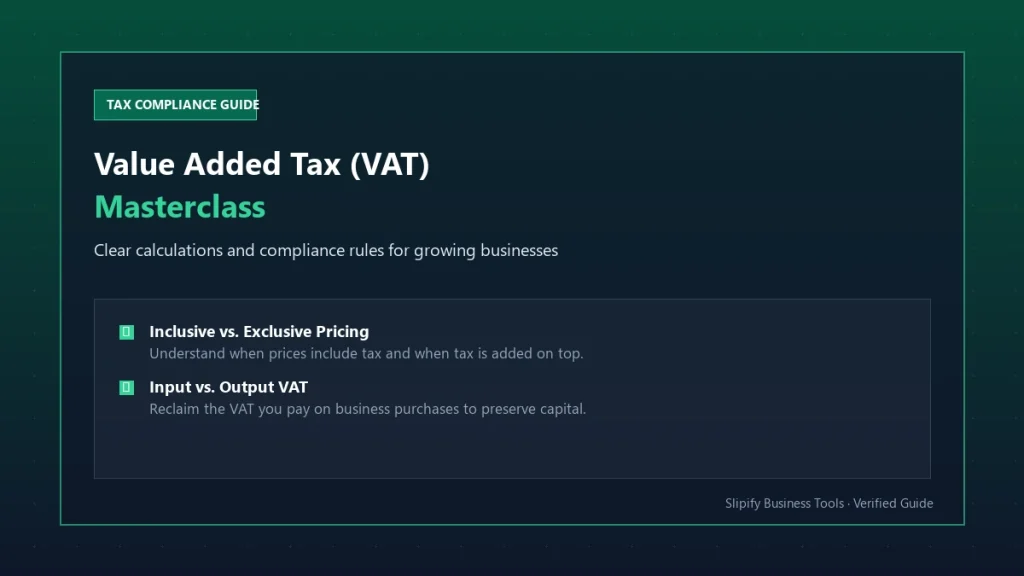
Whether you sell handmade crafts online, operate a digital marketing consultancy, or build software for international clients, you will quickly cross paths with Value Added Tax, commonly known as VAT.
For many small business owners, VAT sounds like an intimidating maze of bureaucratic jargon, confusing percentages, and stressful filing deadlines. However, once you strip away the complicated legal terminology, the core mathematics and logic of VAT are remarkably simple.
Understanding how VAT works is critical for your financial health. If you calculate VAT incorrectly, you could easily undercharge your clients and find yourself paying taxes out of your own profit margin. In this beginner-friendly guide, we will break down what VAT is, explain the crucial difference between inclusive and exclusive pricing, and provide simple formulas you can use every day.
What Is Value Added Tax (VAT)?
Value Added Tax is a consumption tax placed on goods and services at each stage of the supply chain where value is added, from initial manufacturing through to the final retail sale. Over 170 countries worldwide—including the United Kingdom, members of the European Union, Australia, Canada, and South Africa—utilize VAT or its close cousin, the Goods and Services Tax (GST).
Unlike corporate income tax, which is calculated on your company’s annual net profits, VAT is collected incrementally on individual commercial sales transactions. As a VAT-registered business, you act as an official tax collector on behalf of the government: you collect tax from your buyers and remit it periodically to your regional revenue authority.
Output VAT vs. Input VAT
To understand the mechanics of VAT accounting, keep these two foundational concepts in mind:
- Output VAT: The VAT you charge and collect from your customers when they purchase your products or services.
- Input VAT: The VAT you pay to other registered businesses when purchasing supplies, software, or inventory for your company.
At the end of your tax filing quarter, you subtract your Input VAT from your Output VAT. If you collected $5,000 in Output VAT and paid $1,500 in Input VAT on operational supplies, you simply pay the remaining difference ($3,500) to the government. If your input tax exceeds your collections, the government refunds the difference.
VAT Inclusive vs. Exclusive: The Vital Difference
The most common mistake made by new entrepreneurs is confusing tax-inclusive pricing with tax-exclusive pricing. Quoting the wrong type can severely erode your take-home revenue.
VAT Exclusive Pricing (B2B Standard)
When a price is VAT Exclusive, it means the quoted price does not yet include tax. The tax is calculated separately and added on top of the net base price. This is standard practice in Business-to-Business (B2B) commerce because corporate clients can usually reclaim the tax. For example, if you quote $1,000 + 20% VAT, the client pays $1,200 total ($1,000 for you, and $200 in tax).
VAT Inclusive Pricing (B2C Retail Standard)
When a price is VAT Inclusive, the displayed price already includes the tax amount. The customer pays exactly the advertised figure, and you must separate the tax from the total later. This is standard in retail shops and consumer e-commerce. For instance, if an item is sold for $120 inclusive of 20% VAT, you keep $100 and set aside $20 for taxes.
The Simple Formulas to Calculate VAT
You can execute these calculations on any basic calculator without specialized accounting software:
How to Add VAT to an Exclusive Price
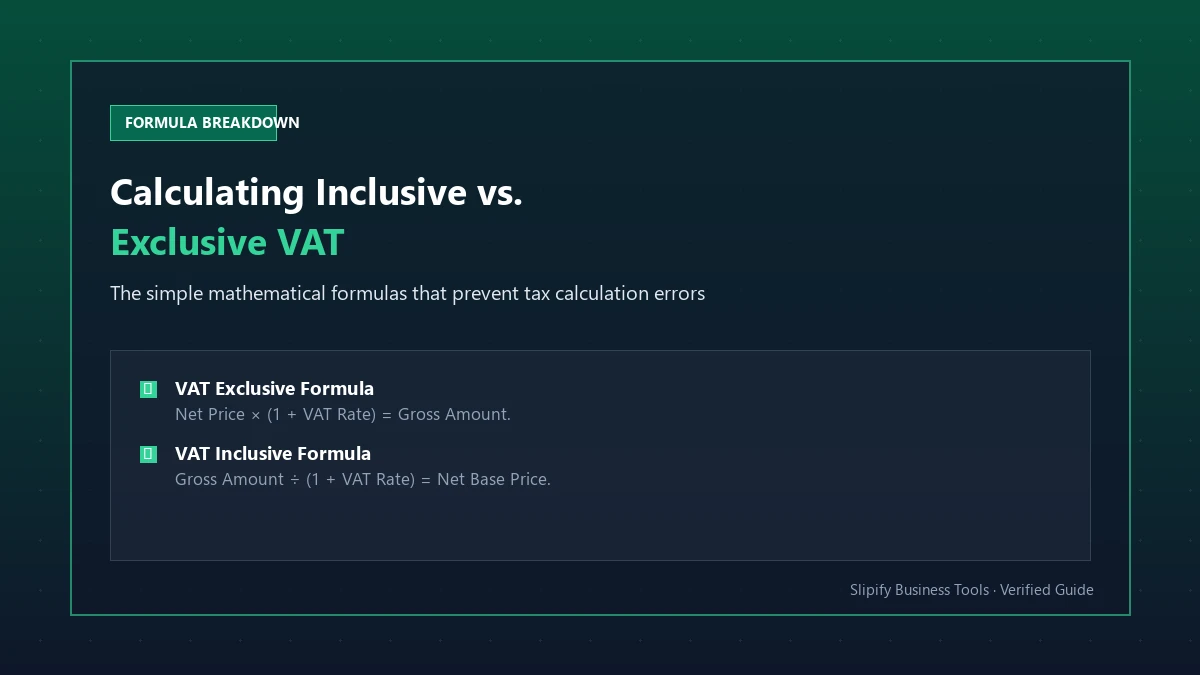
To calculate the gross total from an exclusive price, multiply the net price by the VAT rate as a decimal, then add it to the original amount:
Gross Total = Net Price × (1 + (VAT Rate / 100))
Example: A consultancy project has a net fee of $2,500 with a 20% VAT rate. Multiply $2,500 by 1.20 to reach a total invoice amount of $3,000 ($500 VAT amount).
How to Extract VAT from an Inclusive Price
Extracting VAT from an inclusive total trips up many business owners. A common blunder is taking 20% of the gross total, which results in an incorrect overpayment! Instead, divide the gross amount by 1 plus the tax rate:
Net Base Price = Gross Price / (1 + (VAT Rate / 100))
VAT Amount = Gross Price - Net Base Price
Example: A software subscription costs $120 inclusive of 20% VAT. Divide $120 by 1.20 to discover the net price of $100. Subtract $100 from $120 to find the true VAT amount ($20). You can check your numbers instantly using our free VAT Calculator.
Essential Requirements for a Valid VAT Invoice
When you are registered for VAT, tax authorities require your invoices to meet strict compliance standards so your commercial buyers can legally claim their input deductions:
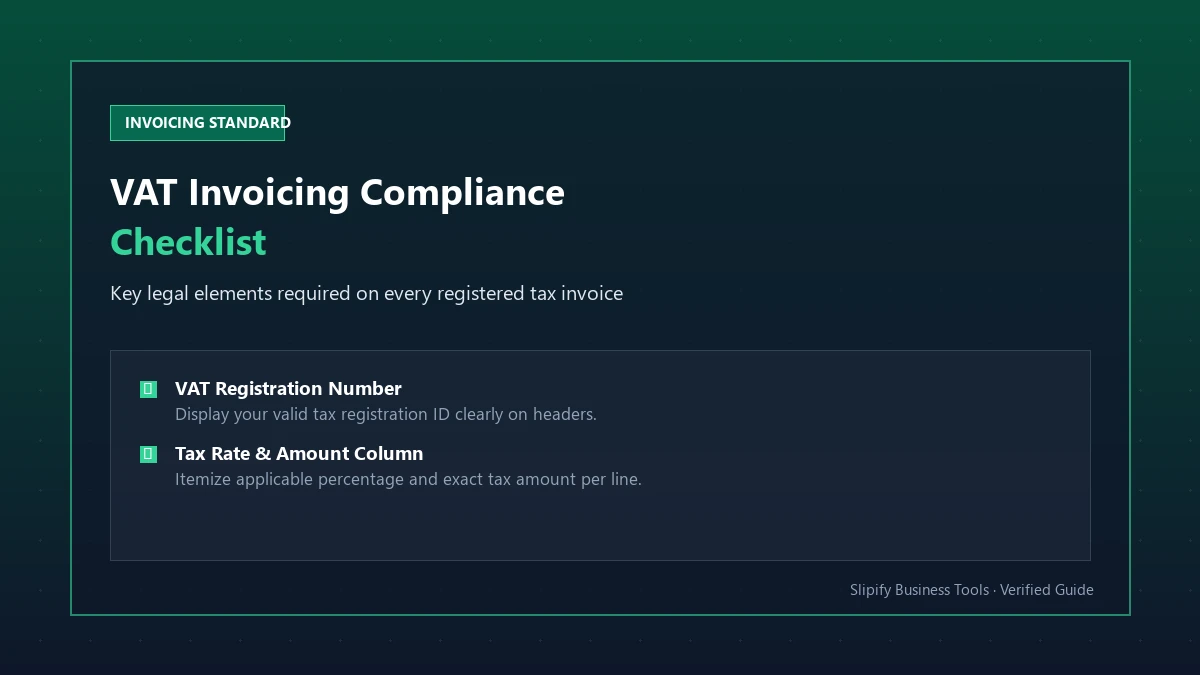
- VAT Registration Number: Display your official national VAT/tax registration ID prominently in the header.
- Invoice Issue Date & Sequential Number: Maintain an unbroken chronological sequence of invoices for audit trails.
- Client Information: Record the buyer’s full business name, address, and their VAT number if trading internationally.
- Clear Price Breakdown: State the net subtotal, the applicable VAT percentage, the exact tax amount in your local currency, and the grand gross total.
Frequently Asked Questions on VAT Compliance
When must my business register for VAT?
Every country establishes an annual revenue threshold. In the UK, for example, registration is mandatory once taxable turnover exceeds £90,000 within a rolling 12-month window. Many growing businesses choose voluntary registration earlier so they can reclaim VAT on startup equipment and signal corporate credibility.
Do I charge VAT when selling services to overseas clients?
Cross-border tax rules depend on whether your client is a consumer or a business. In many international B2B transactions, services are subject to the “Reverse Charge” mechanism or treated as zero-rated exports, meaning you do not charge domestic VAT. Always confirm specific rules with a certified local tax accountant.
Final Thoughts: Master Your Tax Obligations
Value Added Tax is a natural milestone of business growth. By understanding whether you are quoting inclusive or exclusive prices, using proven formulas, and maintaining clean invoice records, you turn tax compliance from a source of stress into an effortless operational routine.