



Starting your freelance career as a designer, developer, writer, consultant, or other independent professional can be exciting. You get more control over your schedule, choose the projects you want, and work with clients from around the world.
But sooner or later, almost every freelancer faces the same question:
“How much should I charge?”
Without an employer setting your salary, it is easy to look at what other freelancers charge, search through online forums, ask a friend, or simply pick a number that feels right.
“$40 an hour sounds reasonable, right?”
Maybe. But there is a good chance it isn’t enough.
Many freelancers discover this the hard way. They spend long hours working, pay for software and equipment, handle their own taxes, take unpaid time off, and still wonder why there isn’t much money left at the end of the month.
The reason is simple: an employee’s salary and a freelance hourly rate are two very different things.
As a freelancer, your rate needs to cover more than the hours you spend working directly for clients.
In this guide, you’ll learn how to calculate your freelance hourly rate, how to account for taxes and business expenses, when hourly pricing makes sense, when to use project pricing, and how to raise freelance rates with existing clients without making the conversation awkward.
The Hidden Trap of the 40-Hour Work Week
One of the biggest pricing mistakes new freelancers make is assuming they can bill 40 hours every week.
It sounds logical.
Forty hours a week × 52 weeks = 2,080 hours a year.
That’s roughly how many hours a full-time employee works in a year. But freelancers don’t get paid for every hour they spend working.
As an employee, you may be paid while attending meetings, taking breaks, completing internal training, answering emails, or handling other company tasks.
As a freelancer, much of your time is spent running your own business.
Nobody pays you separately for writing proposals, looking for new clients, sending invoices, updating your website, doing bookkeeping, or preparing your taxes.
That means you need to distinguish between billable hours and non-billable hours.
If you don’t, you can easily end up charging 30% to 50% less than you actually need.
Billable Work vs. Non-Billable Work
Your working time generally falls into two buckets.
Billable Work
These are hours that directly contribute to a client’s project.
Examples include:
- Writing articles, copy, or reports
- Writing and testing code
- Designing websites, graphics, or layouts
- Conducting research
- Creating marketing materials
- Developing strategies
- Producing client deliverables
Non-Billable Work
These hours keep your freelance business running but usually aren’t directly charged to a client.
Examples include:
- Sending invoices
- Writing proposals
- Marketing your services
- Finding new clients
- Bookkeeping
- Answering emails
- Updating software
- Managing your website
- Preparing tax documents
- Scheduling meetings
Both types of work matter.
The problem is that clients generally pay you for the first category—not the second.
That’s why how to calculate a freelance hourly rate isn’t simply a matter of taking an annual salary and dividing it by 2,080.
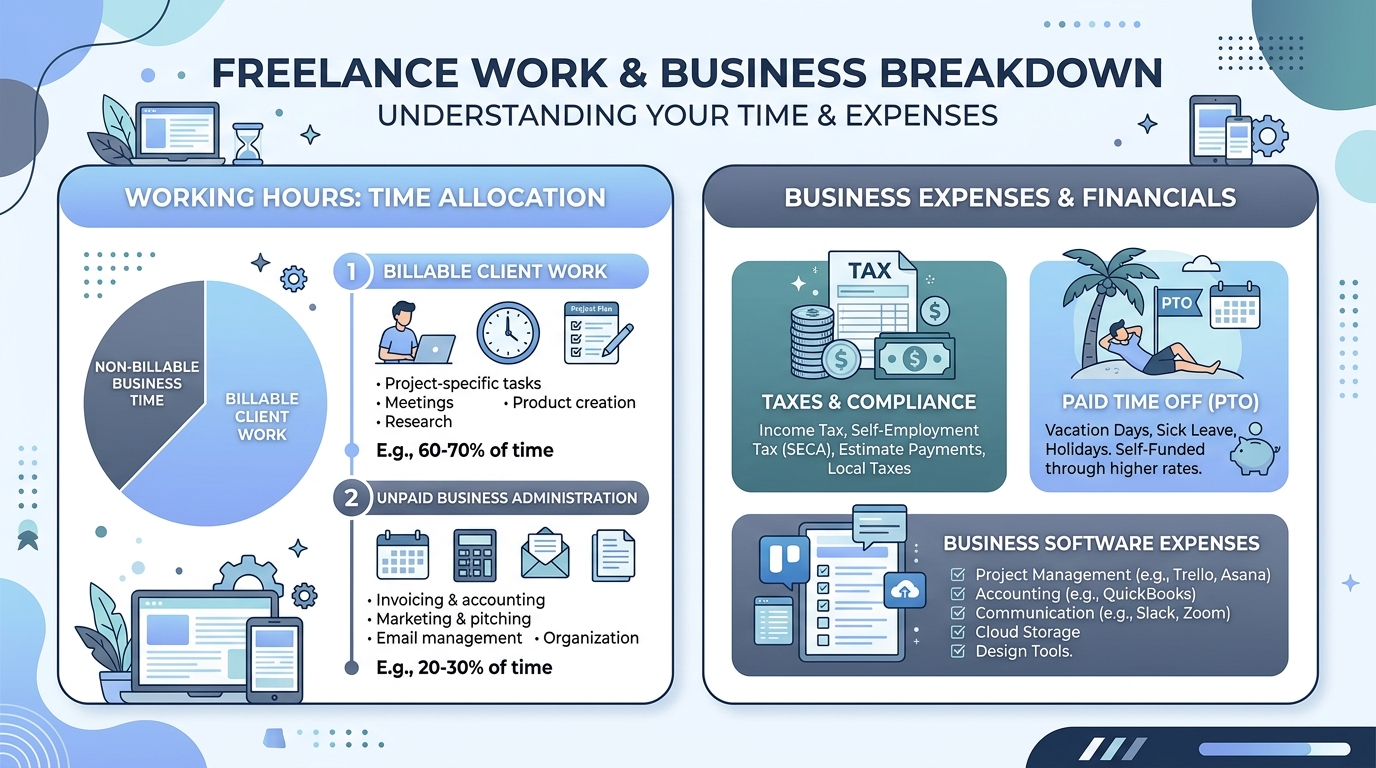
You need to calculate how many hours you can realistically sell.
Industry surveys commonly suggest that a full-time freelancer may realistically bill around 20 to 25 hours per week. The remaining hours are often spent on administration, marketing, sales, communication, and other business tasks.
So you might work 40 hours but only have 20 to 25 genuinely billable hours.
That’s normal.
Your pricing needs to account for it.
Don’t Forget Vacation, Sick Days, and Holidays
Employees often receive paid vacation, holidays, and sick leave.
Freelancers don’t automatically receive any of these benefits.
When you take a week off, your billable income may stop. When you’re sick, you may have no client hours. If you take time away to care for family, your business expenses still continue.
Your freelance hourly rate needs to account for those periods.
Instead of assuming you’ll work and bill for all 52 weeks, use a more realistic number.
For example, you could base your calculation on 46 to 48 working weeks per year.
That might allow for:
- Three weeks of vacation
- Two weeks of public holidays
- One week of unexpected sick days
Your actual number may be different.
The important thing is to be realistic.
Don’t build your pricing around a fantasy schedule where every week is fully booked and every hour is billable.
The 5-Step Formula to Calculate Your Minimum Freelance Hourly Rate
Learning how to calculate your freelance hourly rate doesn’t require complicated financial software.
You can start with five simple steps to determine your Minimum Acceptable Rate (MAR).
Step 1: Decide How Much You Want to Take Home
Start with your personal income goal.
How much money do you need each year to cover your lifestyle, rent or mortgage, savings, family expenses, and the things you enjoy?
Let’s use:
$75,000 per year
This is your target personal income—not your business revenue.
Your freelance business needs to generate more than this because you still have business expenses and taxes to cover.
Step 2: Add Your Annual Business Expenses
Next, calculate what it costs to keep your business running for an entire year.
Include things such as:
- Laptop and computer equipment
- Cloud storage and backups
- Design or development software
- Web hosting
- Accounting tools
- Insurance
- Internet
- Business subscriptions
- Other essential tools and services
For this example, we’ll use:
$10,000 per year
So far:
$75,000 + $10,000 = $85,000
Step 3: Account for Self-Employment Taxes
Taxes are another major difference between freelancing and traditional employment.
As a freelancer, you’re responsible for your own tax obligations, including self-employment taxes and applicable state and federal income taxes.
A practical planning guideline is to set aside around 25% to 30% of gross revenue for taxes. Your actual amount will depend on your location, business structure, deductions, and personal circumstances.
Using a 30% tax buffer for this example adds approximately:
$25,500
That gives us:
$75,000 + $10,000 + $25,500 = $110,500
Your business therefore needs to generate approximately $110,500 in gross revenue to support the target in this example.
Instead of quoting hourly estimates, quote flat project pricing: “$2,000 for complete landing page design and delivery”. Clients receive budget certainty, while you are rewarded for efficiency and expertise.

Step 4: Calculate Your Realistic Billable Hours
Now estimate how many hours you can actually bill.
Let’s assume:
48 working weeks × 25 billable hours per week = 1,200 billable hours per year
Notice that we’re not using 2,080 hours.
That’s because your entire working year isn’t available for client work.
You need time for sales, marketing, administration, communication, holidays, and everything else that comes with running a business.
Step 5: Divide Your Revenue Target by Billable Hours
Now divide your required gross revenue by your estimated annual billable hours:
$110,500 ÷ 1,200 = $92.08 per hour
Your minimum calculated rate is approximately:
$92 per hour
Rather than quoting $92.08, you could round up to $95 or $100 per hour.
You can also test different income goals, expenses, and billable hours using our free Freelance Rate Calculator and Hourly Rate Calculator.
Remember, this calculation gives you a financial baseline.
Your actual market rate can be higher depending on your experience, specialization, demand, location, industry, and the value you deliver.
Hourly Rates vs. Project-Based Pricing
Knowing how much to charge as a freelancer is only part of the pricing equation.
You also need to decide how you will charge clients.
Hourly billing is simple, but it isn’t always the most profitable option.
The Problem With Hourly Billing
Hourly billing can actually penalize you for becoming better at your work.
Imagine you’re a new designer.
It takes you 20 hours to create a landing page.
At $100 per hour, you earn:
20 × $100 = $2,000
Two years later, you’ve gained experience and improved your process.
You can now create a better landing page in just five hours.
At the same $100 hourly rate:
5 × $100 = $500
You’re faster. Your work is better. Your client gets the result sooner.
Yet you earn 75% less.
That’s one reason experienced freelancers often consider project-based pricing.
Moving to Fixed Project Pricing
Instead of selling hours, sell the finished result.
For example:
“$2,000 for complete landing page design and delivery.”
The client knows what the project will cost.
You benefit from your experience and efficiency.
If you can complete the project in five hours instead of 20, you don’t have to punish yourself financially for being faster.
Project pricing also shifts the conversation away from your time and toward the value of the finished work.
For freelancers with strong expertise and repeatable processes, this can be a powerful way to increase income without working more hours.
How to Raise Freelance Rates With Existing Clients
One of the hardest parts of freelance pricing isn’t calculating your rate.
It’s telling existing clients that your rate is going up.
If you’ve worked with someone for months or years, asking for more money can feel uncomfortable.
You may worry that they’ll leave.
But rate increases are a normal part of running a freelance business.
Your experience grows. Your skills improve. Your costs increase. Inflation affects your expenses. Demand for your work may increase.
Your pricing should evolve too.
If you’re trying to figure out how to raise freelance rates, don’t make it emotional.
Treat it as a normal business update.
Give 30 to 60 Days’ Notice
Whenever possible, don’t surprise an existing client with a higher rate on the next invoice.
Give them one to two months of notice.
This gives the client time to adjust their budget and gives you time to answer any questions.
It also makes the change feel professional rather than sudden.
A Simple Freelance Rate Increase Email
If you’re unsure how to tell clients about a rate increase, keep the message short.
You don’t need to write a long explanation or apologize.
Here’s a freelance rate increase email template you can adapt:
“Hi Sarah,
Thank you for being such a wonderful partner over the past year. I’m writing to let you know that starting December 1st, my standard rate will adjust from $75 to $95 per hour.
Because I value our ongoing collaboration, all current milestones and work booked before December 1st will remain at our existing rate.
Please let me know if you have any questions, and I look forward to our upcoming projects!”
The message works because it does four things:
- Shows appreciation
- Clearly states the new rate
- Gives a specific effective date
- Protects existing commitments
That’s all you need.
How to Handle Client Pushback
Eventually, a client may say:
“That’s outside our budget.”
Don’t immediately reduce your freelance hourly rate.
Instead, look at the scope.
For example:
“I understand the budget constraints. If we reduce the revisions from three rounds to one, I can complete the deliverable within your target.”
This approach protects your rate while giving the client another option.
You can reduce:
- Number of revisions
- Deliverables
- Meetings
- Support
- Project complexity
- Scope
- Timeline
The idea is simple:
Reduce what you deliver—not automatically what your time is worth.
Frequently Asked Questions About Freelance Pricing
How do I calculate my freelance hourly rate?
Add your desired take-home income, annual business expenses, and estimated tax obligations. Then divide the total by the number of billable hours you realistically expect to work each year.
This gives you a baseline freelance hourly rate.
How much should I charge as a freelancer?
There is no universal freelance rate.
Your price should cover your living needs, business expenses, taxes, non-billable time, time off, and desired profit.
Your experience, specialization, industry, location, demand, and the value you provide can justify a higher rate.
What is a good freelance hourly rate?
A good rate is one that allows your freelance business to remain profitable and sustainable.
Don’t compare your rate directly with an employee’s hourly salary. Employees may receive paid vacation, sick leave, health benefits, retirement contributions, and other benefits that freelancers have to fund themselves.
How many hours should a freelancer bill per week?
Many full-time freelancers realistically bill around 20 to 25 hours per week.
The remaining time may go toward marketing, sales, administration, proposals, bookkeeping, meetings, and client communication.
Your number will depend on your type of work and business model.
Should I charge by the hour or by the project?
Both can work.
Hourly pricing can be useful when the scope is uncertain or the client needs ongoing support.
Project-based pricing can be more attractive when the deliverable is clearly defined and you can complete the work efficiently.
Many experienced freelancers use both models depending on the project.
How often should I raise my freelance rates?
Review your pricing at least once a year.
You should also consider increasing your rates for new clients when your schedule is consistently more than 80% booked.
A significant improvement in your skills, specialization, demand, or client results can also be a reason to review your pricing.
How much should I increase my freelance rate?
There isn’t one correct percentage.
Look at your current rate, experience, market demand, business costs, and the value you provide.
For example, increasing a rate from $75 to $95 represents a 26.7% increase.
Whether that increase is appropriate depends on your business and your client relationship.
How do I raise my freelance rates without losing clients?
Give existing clients reasonable notice and communicate the change clearly.
Don’t apologize for increasing your prices.
Explain the effective date and any transition arrangements.
If a client has a genuine budget problem, consider reducing the project scope instead of automatically discounting your rate.
What if a client says my rate is too high?
Don’t immediately negotiate against yourself.
Ask what part of the project is outside their budget.
You may be able to reduce the scope, number of revisions, deliverables, or level of support while keeping your freelance rate unchanged.
Should I discount my rates for portfolio work?
Usually, no.
If you want to help a startup, nonprofit, or small business, quote your regular rate and show a separate courtesy discount on the invoice.
This makes your normal commercial value clear while still giving the client a discount.
How can I increase freelance income without working more hours?
Start by looking at your pricing model.
You may be able to increase income by raising your rates, specializing in higher-value services, moving from hourly to project-based pricing, improving your positioning, or working with clients who value your expertise.
Becoming faster and more efficient should ideally increase your earning potential—not reduce it.
Final Thoughts: Your Time Has Value
Freelancing gives you the freedom to shape your work around the life you want.
But freedom is much easier to enjoy when your business is financially healthy.
That’s why pricing matters.
Don’t guess your freelance hourly rate.
Calculate it.
Start with the income you want. Add your business expenses and taxes. Account for non-billable work, vacation, holidays, and sick days. Then divide the total by the number of hours you can realistically bill.
That number gives you a solid starting point.
From there, let your experience and demand guide you.
As your skills improve, your pricing can improve too.
And when the time comes to increase your rates, remember that you’re not asking clients for a favor.
You’re making a normal business decision.
You don’t necessarily need to work more hours to earn more money.
Sometimes, you simply need to charge appropriately for the value, experience, and expertise you already provide.